Project Scope
Build a compact, directional sonar package that improves Ocean Acoustic Waveguide Remote Sensing (OAWRS) for shallow, ice-covered Great Lakes waters.
Project Considerations
- Side lobes reverberate in a narrow waveguide and decrease the signal to noise ratio (SNR)
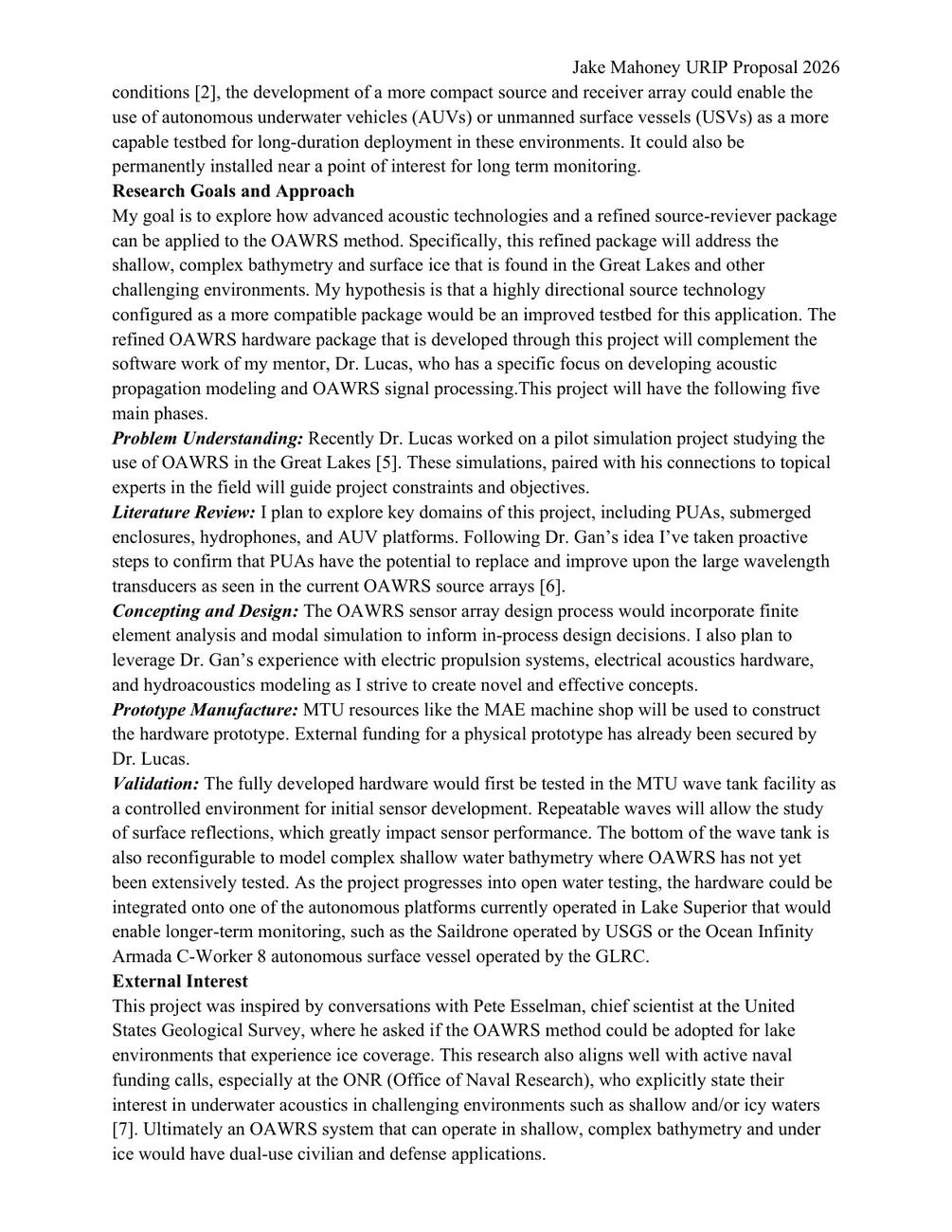
- Existing vertical source arrays are too deep for shallow lake waters
- Ship-towed arrays are less effective and less economical in ice-covered lakes
Design Solution
- Parametric ultrasonic arrays for low-frequency, directional sound from a small transducer
- Compact source-receiver package sized for an autonomous vessel
- Hardware collects the data for my mentors, Dr. Gan and Dr. Evans, to signal process and acoustically model
Project State
- Initial research conducted Spring 2026, hardware development starting Fall 2026
- Validation planned in MTU's wave tank before open-water testing
- Funded by the Great Lakes Fisheries Commission (GLFC)
- USGS has expressed interest in the method for ice-covered lake environments, and ONR support is in pursuit for naval under-ice sensing
Project Summary
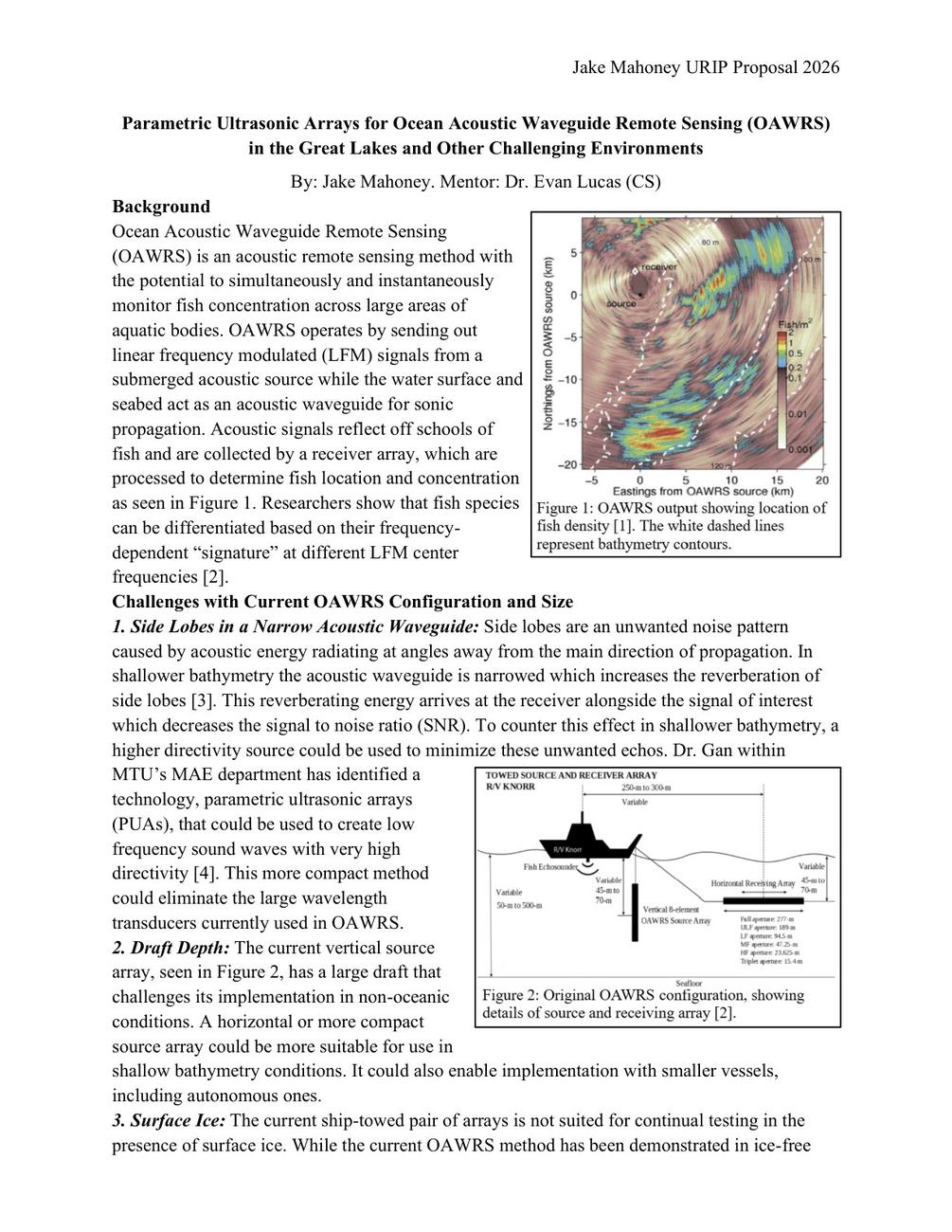
This is a GLFC-funded research project I'm doing as an Undergraduate Research Fellow through Michigan Tech's COE-REU program. Ocean Acoustic Waveguide Remote Sensing maps fish concentration using a submerged source array, the waveguide formed by the surface and lakebed, and a receiver array. The original method was built for the deep ocean which enabled aspects of its design like extremely large source and receiver arrays. In the shallow water and ice covered Great Lakes the current method is not very effective or viable. I'm building a compact source-receiver package around parametric ultrasonic arrays to adapt and improve the method to this new challenging underwater environment.